Thursday, July 7, 2016

Learn How to Take Your Digital Advertising Strategy Mobile

Digital-Advertising-Strategy-Mobile


How many times a day do you pick up your smartphone? If you're the average iPhone user, Apple says you slide to unlock around 80 times in a 24-hour period. Android users unlock their phones around 85 times a day-no word on what those extra five unlocks are.


80 times a day. If the average person sleeps around 7 hours a night, they get 17 hours of waking time per day. That means we're picking up our phones over 4 times an hour. That's more than every fifteen minutes. Should I even bother putting it back in my pocket? Or just graft it onto my hand?


So marketers, riddle me this: Odds are the people you want to reach have a screen on their person that they look at 80 times a day. They fill every idle moment of their day consuming content on that screen.


Why are we still calling it the “second screen?”


Why are we still thinking of mobile as a nice-to-have add-on for our digital advertising strategy?


As Brian Solis (Principal at Altimeter Group, Can Probably Literally See into the Future) said in a recent AdAge article: “Someone has to take the lead in bringing mobile to the forefront of digital design. Investing in a mobile program just to check the box is no longer good enough. The reality is that mobile is now the first screen.”(Emphasis mine)


So what does a first-screen mobile advertising strategy look like? Read on to learn the minimum requirements for mobile, and the specific attributes your strategy should have to succeed.


The Minimum Requirement: A Seamless Mobile Experience


The end goal of your mobile advertising strategy is to pull people to your assets: a piece of content, a landing page, a shopping page. So before you start advertising on mobile, your site has to be mobile-friendly.


But that doesn't mean doing just enough responsive design to have Google bless your site as mobile-friendly. What I mean is that it's possible for your customer to do everything you want them to do, take every step of their journey with your brand, on a mobile device. As our Account Manager and PPC Lead Michael Bak puts it:


We all know that we need to be mobile friendly. But many times I've seen advertisers forget that the customer's journey doesn't simply end at the landing page. You need to make sure every aspect of the customer journey is mobile friendly: the shopping cart experience, the asset, the area of the site you're funneling that consumer to. Make sure you're asking your customers to take the next step. And make sure that next step is part of a seamless mobile experience.


So before you start implementing a mobile advertising strategy, make sure those who demonstrate their trust by clicking on your ad are rewarded with a positive experience.


What Does a Mobile Advertising Strategy Look Like?


Mobile screens are unique in that they're more personal, more intimate, and more user-customizable than marketers are used to (or comfortable with). You know what I'm talking about; you're a consumer as well as a marketer. We're used to ignoring advertising on mobile. We're good at mentally erasing the banner ads at the top of apps. We click X on interstitials before they even load. And the ads we can't mentally block, we can now use software to actually scrub away.


That's the downside of mobile. It's a screen people spend a whole lot of their lives looking at-but they're emphatically not looking at what you want to show them. That truth informs all the following aspects of a successful mobile digital advertising strategy:


It's Social. What are people doing most of the 80-85 times they unlock their phones? Why, checking their social media for updates, of course. That's where they want to be-so that's where you should be, too. Promoted, targeted posts on your audience's preferred social media channels are an easy way to get guaranteed mobile-friendly, less-likely-to-be-ignored advertising.


It's Visual. With their big screens and powerful processors, modern mobile devices are made for visual content. You don't have to set up your own VR studio just yet, but images and at least some video are a must. Facebook and YouTube are both developing tools to make video creation easier; you can bet the output from those tools will be optimized for mobile. Take it from Lowe's' millions of plays on Vine, or FedEx's 46,000 followers on Instagram: mobile platforms + social + visual content = awesome.


It's Native. Like I said earlier, we're getting very good at unseeing the kind of banner ads and interstitials that might have attracted eyeballs a few years ago. These days, native ads have a much better shot at being seen. Mobile native content (on apps like Facebook, Buzzfeed, and Reddit) has multiple advantages: It's immune to ad blockers, it's already optimized for mobile, and it finds your audience on the apps they already use (more on that later). 


It's Useful. Remember when all an advertiser had to do to rake in the dollars was put a mini-game in their banner ad? You know-help the monkey collect bananas, punch the boxer, shoot the baskets? Yeah, that's done with. Now there's plenty of opportunities for people to mindlessly tap and swipe. To get their attention, you actually have to offer something of value. Make it entertaining, make it emotional, make it hilarious-make it worth their while.


It Not All on Your Site (And Especially Not Your App). We've talked about having a solid mobile-friendly site. The logical next step seems like developing your own app, to really provide the best user experience. But the average smartphone user spends most of their time in just three apps. Do you really want to gamble on your app breaking the top three? It makes more sense to find which three they use, and publish there.


It's…email? You heard it here first (unless you heard it first somewhere else): Email is a mobile advertising strategy. Way back in 2014, 65% of email was opened first on mobile, and you can bet that number has gone up. Email is the perfect diversionary activity after all the Faces have been Booked, the Tweets have been Twitted, and the Snaps have been Chatted. If you can consistently deliver valuable content via email, you can grow your audience regardless of their demographic. From Millennials to Baby Boomers, mobile has breathed new life into email as a marketing tactic.


Quick, to the Mobile-mobile!


Last year, Google announced that more searches are now being made on mobile than on desktop. Internet traffic from smartphones and tablets is slowly eclipsing all other forms of traffic. That's not to say we should cut non-mobile users loose and leave their money on the table, of course. But it does indicate that mobile is far more than the secondary consideration many marketers have made it.


How is your organization developing a mobile advertising strategy? Let me know in the comments.


Email Newsletter
Gain a competitive advantage by subscribing to the
TopRank® Online Marketing Newsletter.


© Online Marketing Blog - TopRank®, 2016. |
Learn How to Take Your Digital Advertising Strategy Mobile | http://www.toprankblog.com

The post Learn How to Take Your Digital Advertising Strategy Mobile appeared first on Online Marketing Blog - TopRank®.


How to Get Past the Dreaded SEO Plateau

Your SEO efforts have been paying off with steady website traffic... until the inevitable happens: Organic traffic stops growing. But getting past the "SEO plateau," one of the greatest challenges for online businesses, is possible. Read the full article at MarketingProfs

A Framework For Assessing The Impact Of Your Blog On Company Sales

  Content has long been hailed the king. With blogs being the first home to content, they are the vehicles that drive online marketing. The overall impact of a blog, in terms of the social value it generates, is long-standing. […]

Post from: Search Engine People SEO Blog


A Framework For Assessing The Impact Of Your Blog On Company Sales


--
Written by Michael Georgiou, Imaginovation


The post A Framework For Assessing The Impact Of Your Blog On Company Sales appeared first on Search Engine People Blog.


Stop Overspending Time and Money on Marketing Techniques That Don't Work

I hate to see money wasted on outdated online marketing techniques.


It's not just about money, but also about time and resources that could be used in a better way. Marketing budgets are often tight, and you just can't afford to spend them on strategies or things that don't work.


To help you cut waste and make your marketing strategy more effective, I've created a list of six most common ways small and medium sized businesses lose their budgets online. Here's how to stop overspending time and money, and turn those losses into gains.


1. Using “Guaranteed SEO Services”


SEO is not an exact science and getting results overnight is a myth. Google's algorithm has become smarter and smarter in the last years and there are no easy shortcuts. It's commonly known that Google uses hundreds of ranking factors, but the truth is that no one knows precisely what all of those are. With time, you get to learn what techniques work better, but anyone that offers guarantees to rank a site on the 1st position for a particular keyword is a scammer.


Google warns people not to buy SEO services from companies or freelancers that guarantee to rank 1st for any given keyword. Here's Google's take on guaranteed SEO:


google-seo-firm-warning


If you are not experienced, you might be tempted to choose an SEO company that guarantees you'll rank first for your main keywords over a company that doesn't offer this guarantee. Makes sense, right? But it doesn't.


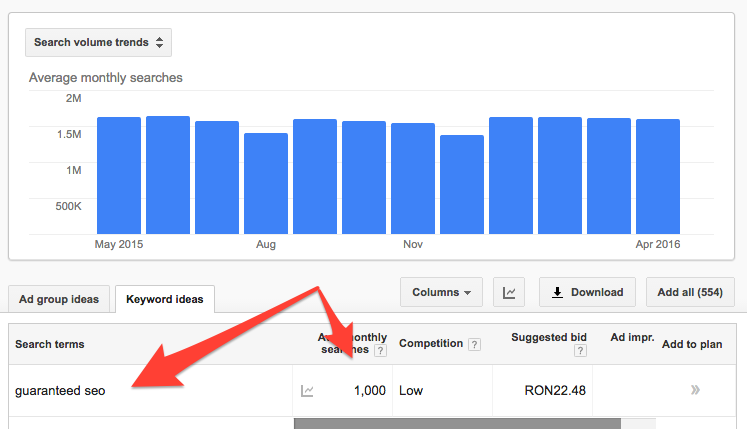
The SEO companies that offer such guarantees are commonly formed by black hat SEOs that are not fully committed to making your website successful. They are just fine with taking your money for 3 or 6 months, and don't care so much that eventually you'll leave disappointed. That's because at least 1000 of potential new clients search in Google each month for “Guaranteed SEO”. They can easily find another naive person to sell them guaranteed SEO services and replace your contract.


search-volume-trends


Be very picky and skeptical when choosing an SEO firm. If you don't know where to start, Moz has a list of recommended SEO companies.


2. Buying Social Media Followers


The number of followers you have on social media is simply pointless. What matters is the engagement and how many real users see your posts. It's not like in your childhood when it mattered if you or your brother had a bigger portion of goodies. Many fall into the trap of believing that the more followers their business has, the more trusted and reputable it will be.


You should never buy social media followers. Neither on Facebook, Twitter, Pinterest or whatever social media platform you choose to use for your sites. Bought “followers” are fake and besides being a waste of money, you can also end up having your account suspended.


3. Not Measuring The Success And ROI For Your Marketing Campaigns


All businesses and industries are different and therefore what works great for some, might not work as good for others. For example, social media can be a golden nugget for sites in the entertainment or technology industry, but for a business that sells forklifts will not be as important. Just because a channel works great for most sites doesn't mean that you should block your resources on something that's not suitable for your type of business.


To succeed with online marketing, you have to analyze and measure the success of all your campaigns and then focus most of your attention on the channels that give the best return of investment. Use an analytics tool like Kissmetrics to see where your site traffic is coming from and check how the visitors are funneling through your website.


It's critical to measure how well your marketing campaigns are performing and know what you should prioritize for the future. If social media doesn't work well for your site, you can focus more on creating quality content, or maybe launch a better advertisement campaign.


The most common mistake marketers tend to do is not to measure their campaigns and sources of conversions on a regular basis. It's not enough to check what works best for your site once and then take decisions upon what you've discovered on that analysis. Each week, marketers should check what worked best and how the conversions are going for each channel. Marketers can do all of this within Kissmetrics.


4. Content Marketing Done Wrong


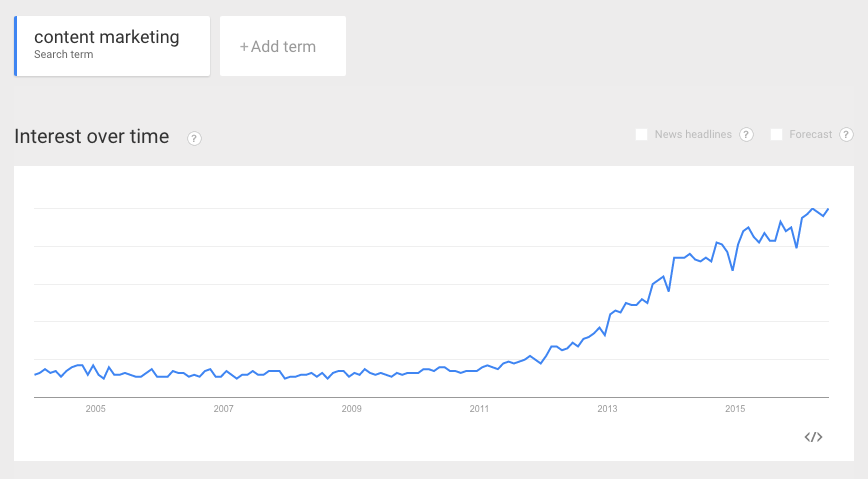
The interest for content marketing has grown to unexpected levels in the last years. It's estimated that the whole industry is worth roughly $190 billion and it will grow to $300 billion by 2019.


content-marketing-interest-overtime


Content marketing is about creating content in the form of videos, articles, infographics, images, slideshows, etc. With the industry growing so quickly, the competition is also becoming stronger and stronger. Quality is the differentiator between a good and a bad content marketing campaign.


The main reasons why most of your content marketing campaigns fail is because:


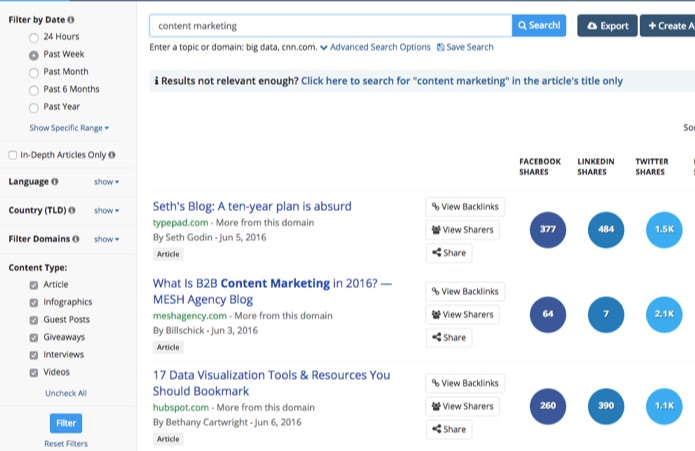
  • You don't write about topics that people are really interested in. Sure, it's your blog and you can write about whatever you want, but if you are aiming to get more visitors, you have to research your topics. With the help of BuzzSumo, bloggers can find what content from other sites is performing great on social media. It's a simply way to finding what works best for your competitors and what gets the most shares. The tool gives you access to an endless resource of topic ideas.

    content-marketing-buzz-sumo


    It's also a good idea to check what key phrases people use to do searches in Google. For that, Google's keyword tool can be very handy.

  • You don't promote the content campaigns you have created. It's not enough to write an article, video or build a great infographic and then move on. Just because you've clicked the “publish” button, it doesn't mean that your job is over. Not even close. You can't just create some content, and hope that it will go viral. Things don't work that way. Chances are nobody will ever find your new piece of content, unless you try to promote it. Do outreach and try to promote the content through influencers.

  • You content marketing campaign has no value. You see low-quality content marketing campaigns everywhere. If the content you've created doesn't bring value to the reader, don't bother publishing it. Instead of posting 10 useless articles or videos, try to make one that will stand out as the best in the niche.

    It's the same with guest blogging. There's no point to write for sites that have no authority and no one has heard about them. Don't spend your time and budget to write for several low-quality sites, but instead aim to be a contributor on the big sites in your industry.


5. Not taking backlinks seriously


Backlinks are important not just for SEO, but they can also send relevant referring traffic, help you build partnerships, bring you customers, and measure the success of your online marketing campaigns. Sadly, many tend to ignore backlinks and rarely check the ones of their site.


If you are running a content marketing campaign or simply doing outreach to promote your website, besides checking analytics, it's also important to check your site's backlinks. That's so you can know whenever a site links back to you and see how successful was your outreach campaign. If your content marketing campaigns are not generating quality links, you might have to reconsider your strategy.


Here are several reasons why everyone should pay more attention to backlinks:


  • Backlinks are the main ranking factor for Google and Bing and they will continue to be for the coming years. A site that has good backlinks will rank higher for more related keywords and get more traffic from search engines.

  • Bad backlinks acquired naturally or because someone has built them to your site can drag your site down in the SERPs. It's important to know whenever your site gets new backlinks or otherwise all your SEO efforts will be pointless and you'll end up wasting time and money.

  • Backlinks can tell you when a blogger sends a link to your site. You can thank them for recommending your site, and perhaps build a partnership with them.

  • Backlinks can show what websites are referring the most traffic to you, and you can try to get more of the same.

  • If you are buying ads through banners, it's important to know if the advertiser removes the backlink.


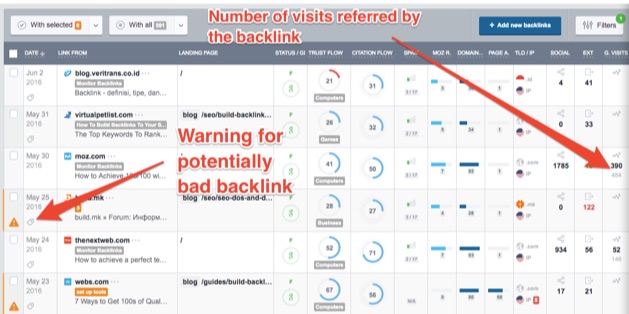
To be up to date with all your site's backlinks, you can use the SEO Tool Monitor Backlinks, which sends you an email whenever your earn or lose links. Besides the email alerts, the tool shows more than 15 different metrics for each backlink, to help you easily see in a glance their SEO quality. Another useful feature is the warning sign that is showed for links that have questionable metrics.


seo-tools-monitor-backlinks-screenshot


To prevent organic traffic loss, it's advisable to often check your site's backlinks. SEO is one of the best online marketing channels that can generate traffic, even if you are in a boring niche. If you've hired someone to do SEO for you, you still have to check your site's backlinks. Don't sit back and think that everything will be alright. Your business responsibility is still in your hands and you are the only one that's going to lose in case something goes wrong.


One of the worst mistakes people tend to do about backlinks is thinking that they need hundreds or thousands of links to rank high in Google. All that matters is QUALITY. The number of links you have is not important and you shouldn't be obsessed about it. It's best to have 10 quality links rather than 1000 backlinks from unknown sites.


6. Outsourcing To Bad Companies


As your online business starts to grow, you can start to consider outsourcing some of the tasks to a specialized company. You can outsource social media, content marketing, SEO, advertising management, etc. Whatever you outsource, don't forget that you are still in charge and you can take over if the results are not the ones you expect.


There are numerous cases where companies are outsourcing services to a bad content marketing or SEO firm. However, they keep using their services. That's because when outsourcing, companies tend to rely solely on the reporting provided by the outsourcing firm.


If your results are not close to your expectations, and you have a feeling that your money are being wasted, take action before it's too late.


Conclusion


It's hard to succeed with online marketing without measuring all your channels correctly. Set your KPIs and don't be afraid to change or stop working on a channel that's consuming too much financial and time resources.


Be very doubtful when choosing to work with an outsourcing company and continue to use your own tools to measure the success of their campaigns.


About the Author: Felix Tarcomnicu is an Internet marketer with a strong passion for SEO and social media. You can follow him on or Twitter @FelixTarcomnicu for similar articles.


Wednesday, July 6, 2016

Which Channels Do Customers Trust for Branded Content?

You know that when it comes to getting an unbiased, credible, and trustworthy review of a product or service, you're most likely to turn to family and friends.  But what about branded content? Are blogs a reliable source of information? Can social media be trusted? Where are people getting their brand information and how much of an influence do different media channels have?  Let's take a closer look.


What Is Branded Content?


Previously, the idea of “branded content” was so new and innovative that it didn't really fit into any single category. It's not the same thing as advertising, but it is anything that makes people think about or associate with a brand. Confused yet?  Here's a better way to simplify it.


Avi Savar, creative head and founder of Big Fuel, a social media and brand growth firm defines branded content as the difference between “people stories” and “product stories”.  He explains, “Traditional advertising is about delivering features, benefits, and a USP through a product story, and then finding creative ways to connect that to people.”


He continues by saying that, “Branded Content is sort of the reverse of this. It's about starting with people stories first, so what are the things that can help brands connect with the hearts and minds of their audience, and then thinking about how you can creatively link that to your product.”


One example of branded content in action is the following video ad from Chipotle. This ad actually won an award for its creativity and was designed to align Chipotle with responsible agricultural practices in the consumer's mind, rather than cheap burritos.


Chipotle wants people to envision them as more than just “cheap burritos”


Other well-known examples of branded content include the famous Volvo epic split campaign, which in addition to getting the “Wow!” factor from a wide audience, gets its core audience (truckers) to ask “How can those trucks go in reverse so smoothly like that?” Another is the Dove Real Beauty campaign, where a sketch artist drew images of women based on how they described themselves versus how others saw them.


Although, in the example of Dove, the campaign originally aired in 2013, it's still being viewed today and with nearly 67 million views and over 75,000 users subscribed to Dove's YouTube channel, anyone can easily look at this branded campaign and see how it touched people's emotions.


Branded Content and Media Outlets


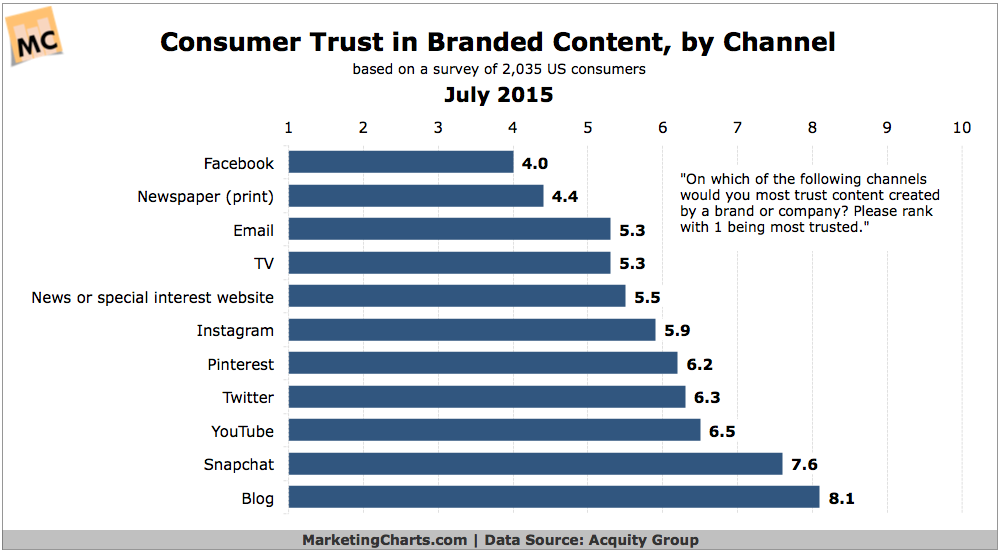
Acquity Group looked at which media outlets customers were more inclined to trust when it comes to branded content. As it turns out, some sources have a surprising amount of credibility:


AcquityGroup-Consumer-Trust-Brand-Content-by-Channel-July2015


Facebook comes out on top, followed by print newspapers, email and television. Rounding out the bottom are Snapchat and blogs.  It's worth noting that according to the study, younger respondents aged from 18-30 were more than twice as likely as baby boomers (aged 52-68) to give Facebook the top rank among branded content.


In case you were wondering, older consumers gave the newspaper their most trusted vote. As for advertising influence, TV and social media alike were near the top, while older Americans found print and direct mail of greater influence.


Who's Doing the Sharing?


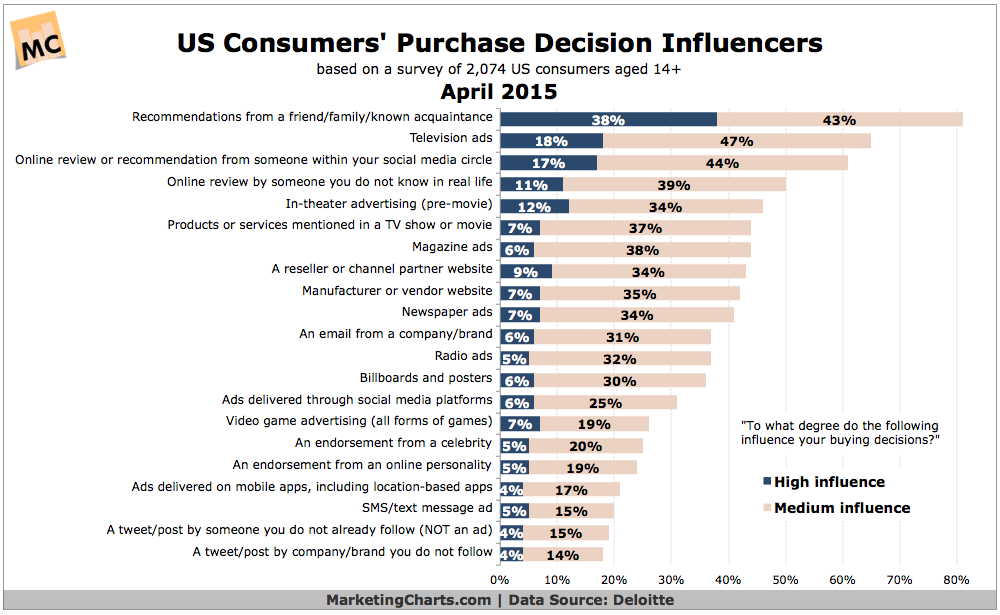
Now, before you rush off to create a cavalcade of Facebook ads featuring your company's branded content, you should know that people are far less likely to share a post directly from the company itself. Instead, they're most likely to share a product link when it's recommended by family or friends:


Deloitte-US-Consumers-Purchase-Influencers-Apr2015


Family, friends and acquaintances hold high sway over consumers' purchasing decisions


What kind of “brand content” Facebook posts are we most willing to share. The all-encompassing “funny video” still gets the most shares, but it's closely followed these days by content that is designed to support a cause or organization.


With branded content, you're essentially borrowing the customer's time and thanking them by making them feel something – laughter, insight, amazement.  Although the ads referenced above are designed to make you think, the company behind them is secondary to the story they're sharing.


And if more people become invested in that story, they'll want to tell others, and the cycle continues.


Now you're probably wondering, “branded content sounds great – but how do I make the most of it?”


Content marketers are already struggling to squeeze ROI out of their campaigns in a way that's meaningful to managers and executives alike, so here's how to start making branded content work for you:


Getting Started with Branded Content


First off, Facebook only allows branded content from verified pages – meaning you'll need to have that coveted “blue checkmark” next to your name (or a grey checkmark if you're a business) in order to take advantage of this type of promotion.


The link above describes how to go about verifying your business account on Facebook, or if you're an individual, how to see if you're eligible to be verified.


Once you're verified, you can get started with branded content by going here.  Nearly any type of content can be tagged as branded content, including photos, videos, text (with and without links), live videos and more.


How do you know it works? Because you'll see not only the company name being mentioned, but also the key “with” – and then those tagged in the post:


live-example


Now, any time the post is shared, those tagged in it will also benefit from the exposure. It's a win-win.


What's The Difference Between Branded Content and @Mentions?


Excellent question! The difference between branded content and your typical @Mention is that the brand which posted the page gets analytical insights that wouldn't ordinarily be available in an @Mention.


It's important to mention here that if you're tagged, you'll still get to see the post's organic and paid engagement, sort by organic versus paid or fans versus non-fans – and otherwise see much of the same data as the owners of the branded content themselves. So although it's not specifically coming from your page, you'll still get to see a lot of the details that a simple mention wouldn't have.


Now, tie this kind of content leverage in with your own UTM parameters and conversion goals and you'll be able to see precisely how well your branded content is performing and converting.


Squeezing Every Drop of Trust and Credibility Out of Branded Content


Let's face it, you're already creating content. Why not take to the channel consumers trust the most and make your content work even harder for you?  You'll be getting vastly more exposure when coupled with influencers in your industry and getting people to take action on your content in ways that a typical ad just can't match.


What are your thoughts on using branded content? Has your company used this method effectively to increase trust, brand recognition and awareness among your target audience? Share your thoughts and impressions in the comments below


About the Author: Sherice Jacob helps business owners improve website design and increase conversion rates through compelling copywriting, user-friendly design and smart analytics analysis. Learn more at iElectrify.com and download your free web copy tune-up and conversion checklist today! Follow @sherice on Twitter, LinkedIn or Google+ for more articles like this!


How You Can Conquer These Three Negative Content Trends

Increasing content noise and competition, greater reliance on pay-to-play content promotion models, and over-promotion and channel saturation that sabotage your marketing efforts... You can conquer those negative trends. Read the full article at MarketingProfs

A 9-Part Client Management Manifesto Your Agency Should Steal

Posted by brianspatterson

It was my first day at my new gig as a federal government IT consultant in Washington, D.C. I was slogging through the typical onboarding paperwork when a senior partner dropped by, introduced himself, and handed me a paperback book.

“Read and implement this,” he said. The cover read The Trusted Advisor by David H. Maister, a book with a sole focus on “the ability to earn the trust and confidence of clients.”

“Client management must be important,” I thought.

This encounter occurred more than 10 years ago, in my previous profession. Before doing search marketing or SEO, I was a government IT consultant. I navigated bloated systems and untangled red tape. In the time I spent consulting at the FBI, ICE (U.S. Immigration and Customs Enforcement), and the CBP (U.S. Customs and Border Protection), I learned quite a few lessons that apply directly to the SEO industry.

The most important lessons I learned, perhaps, were about the art and science of effective client management. Many of those lessons learned have become standard operating procedure at Go Fish Digital. What follows is the codification of our client management approach. It isn't a sexy new link building strategy or a mind-blowing algorithm update, but it's just as critical to the success of a project.

Overarching client management principles

To start, the following overarching principles help set team expectations. The three core areas that guide our client engagements are:

  1. Transparency: The majority of our tasks and communication take place in a project management tool (Basecamp) that the client has access to. We want them to see and participate in our discussions, questions, and decisions. By not having this process behind closed doors, we can always go back to when and why a decision was made within Basecamp.

  2. Continuous communication: We communicate at the pace the client prefers, but we err toward over-communicating. To a client, radio silence means no work is being done, even if that isn't truly the case.

  3. Alignment: What are your client's key performance indicators (KPIs)? What problems keep them up at night? We make sure to align our work and reporting with what is important to the client, rather than only pushing what we think is most important.

The following nine principles are built out of these three core areas, highlighting how you put these principles to work in day-to-day interactions with clients.

It should be noted that these aren't hard and fast rules, but rather a philosophy to guide our team (and hopefully other agencies) on how to become trusted partners with your clients. It is hard to be perfect all the time (I sure as hell am not), but the more often these nine items are standard operating procedure, the better. So let's dive in, Star Wars-style.

1. Take the time to learn the industry

ll9jjQ8.jpg

I got the call from a team member to let me know a new referral had come our way. He was excited because it was a strong referral and very likely to become a client soon. I asked him about the project and what industry they were in. “Plastics machine manufacturing” was his response. Interesting... I knew next to nothing about that industry. Yet, we were very likely to have them as a client to help them market their products online. The first thing we needed to do was understand the industry, and we did this by diving in head first to learn everything we could about the plastics manufacturing lifecycle.

To make sure we have a solid foundation for a client's niche, the team conducts a lot of discovery in the first month, such as:

  1. Reviewing the client's website

  2. Identifying industry publications and blogs and reading them consistently

  3. Scheduling an in-person visit (if possible) to see how they work and meet the team

  4. Requesting any documentation they have about their products or services

  5. Watching online videos highlighting the industry, their products, and their team

  6. Building a lexicon document that includes jargon and definitions of words commonly used in their industry

  7. Purchasing and using the product or service ourselves (if reasonable and feasible)

As an SEO and marketing consultant, you will not be an expert in every client's industry. But, it is important that you learn their space. This builds their confidence in you, helps you learn their language, and establishes trust.

2. Crush it on the kickoff call

ghReTMF.jpg

We were kicking off an online reputation management (ORM) project with a celebrity's publicist and assistant. Prior to the call, we gathered everyone in the company that was a fan of this celeb and did a quick research session so we were all up to speed with his movies, causes, friends, and issues. For the kick-off call, we built a detailed agenda which contained specific topics and questions. The call left the client team feeling at ease that we understood the issue and how to fix it. As a team, we were pleased that all of our early legwork (and TMZ watching) paid off.

After the sales process, the project gets handed over to a client manager like myself. The first thing I do is get a kick-off call scheduled quickly with the client and anyone from their side who will be on the project. Since this is one of your earliest communications with the client, it sets the tone for the entire engagement, so you want to be organized and responsive in getting this meeting set up.

We include on the call anyone from our team who might touch the project. This way, they hear everything from the client at the start, and the client feels good because so many people are working hard on their project.

We always build an agenda for the kick-off call, and I make sure that there is at least one item that each person on our team can speak to. This allows each employee to demonstrate their expertise in the beginning and build a relationship with the client. If it's a phone call, the client may forget just how many people we have working on the account if only one or two people speak during the meeting.

3. Have open, visible tasks and team discussions

d3DvQ7V.jpg

We've been working with Amy for several years now, and she continually expresses her gratefulness for our transparency. Amy is a senior employee at a data security firm and is often traveling and working on other projects. By keeping track of every task on Basecamp and looping her into our work, she is able to quickly skim through completed tasks and see exactly where we stand on every project. She sees not only what we've accomplished in her absence, but also what's on the horizon. Additionally, she can be directly emailed with any pertinent messages and chime in with a response to keep everything moving forward.

The goal here is to show everything except how the sausage is made. Why would you want to hide all of the time-consuming, difficult, and sometimes menial tasks you're doing? Showing the client everything we are doing for them helps drive home the value of our service and keeps them from getting antsy about the occasional slow result.

The only place where we hold back a little is on drafts of deliverable reports. We keep those in our team Dropbox and simply reference the folder path when discussing them on Basecamp. We've found it keeps clients from getting hung up on things that we haven't quite finished.

4. Respond within 24 hours

cjFT3xq.jpg

I was just breaking into online marketing when I heard something on the radio that caught my attention. My favorite show, The Sports Junkies in Washington, D.C., were looking to build a website for a new venture. They talked about how annoying it was to work with web designers because things always get difficult. In a moment of inspiration, I sent them a short pitch email that ended with, “Messages don't sit around in my inbox. I respond immediately.” The next morning, someone from the show emailed me back, saying “I'm not sure why exactly, but I think I can work with you." I've worked closely with them ever since, and that relationship has helped springboard the Go Fish Digital brand in D.C.

From that original encounter on, I've always placed a high value on responsiveness. You know that person in your life who feels like you're late if you're on time? That's how we are with this 24-hour response time rule. If you truly take 24 hours to acknowledge a client's request, it may be within the time frame, but it isn't honoring the spirit of the rule itself (37 pieces of flair, anyone?). It doesn't take much to send a note saying, “We are on it”.

This is another area in which we err on the side of overdoing things. Even if the client sends an email that might not normally warrant a response, we still ping them back to let them know it was received.

One of the chief complaints about service-based companies is a lack of responsiveness. Counteract that by being committed to quick responses.

5. Be organized

Fi23z53.jpg

The director of marketing at a large financial organization likes to meet with our team weekly. We review the previous week's progress and talk through our tasks for the next few days. This client is especially chatty, so without a formal agenda in place, there was the potential for the calls to devolve into a free-for-all, which would be inefficient for everyone. Because of situations like this, we always send a formal agenda ahead of time, which keeps us all on track and demonstrates to the client that we understand their goals and respect their time. Of course, we always allow our clients to ask questions or bring new things up. For the most part, though, we try to stick to the agenda.

Disorganization is frustrating. Sometimes you just have to deal with it. A spouse or child who misplaces everything, a friend who can't remember an appointment, or a co-worker that never replies to important emails. While in these instances there is nothing you can do, a client who's fed up with her vendor's disorganization can simply get a new vendor. So we stress the importance of being ultra-organized on the project.

Have well thought-out agendas. Follow those up with meeting notes and action items if appropriate. Keep Basecamp organized with to-dos and messages. Communicate clearly. Always use calendar appointments. It's the little things that show you are professional.

6. Be flexible and adaptable

xRluZx0.jpg

We work with a large car sales website that aggregates all car listings from across the web. When you're dealing with a site that has over 3 million pages, it's important to focus on optimization opportunities that scale. We identified site speed as one of these optimization opportunities. The site had been particularly laggy, and I was doing my best to get to the bottom of the issues with their CDN. Alas, I was stuck.

Fortunately, one of our other team members is Akamai certified and has configured CDNs for multiple large government websites. I looped him in; he started throwing around big words like “nodes” and “end points.” Some magic happened, I assume, and everything was fixed. The site was now blazing-fast and the client happy that his SEO team resolved an issue he didn't even know they could help with.

No project is ever the same, which is great. How boring would it be if you applied the exact same strategy and principles to different projects, over and over?

We're always looking for ways to show additional value to the client. Whether it's by helping them with something out-of-scope or helping with deliverables that they have to pass on to senior management, there are always ways for us to contribute value. Although there's nothing wrong with up-selling, we don't often like to say “that is out of scope” for a task that wouldn't take us too long or be too difficult.

Additionally, we're very flexible in terms of how we work with a client. Is the client a phone person or email person? Are they hands-off, or intimately involved in the details? We try to get a good feel for this, and then adjust how we work with them based on their preferences.

7. Be in front of the technological curve, not behind it

8XSqlYl.jpg

Our new yacht charter client had just finished their first month with us and we were reviewing everything that had been done thus far. It was all very positive, and during the call, the CEO casually said, “I love the internal communication tool (Slack) so much that I've started using it at my other company.” Clients want to feel like you are doing things efficiently, effectively, and with the latest technology.

In our field, change is the norm. Every time Google launches an algorithm update, it can mean that a tactic that's worked for us for months or even years is suddenly obsolete. We've found that one of the best ways to avoid any surprises here is to stay ahead of the curve when it comes to strategies and tools.

I've mentioned our project management tool, Basecamp, a few times now. It may not have all the bells and whistles of others, but it's dead simple to learn and our clients pick it up without any help from us.

We also use Slack both internally and with clients for brainstorming sessions. Slack provides quick access to the entire team, which is helpful for most of our day-to-day communication.

In addition to tools, we've found that everyone on the team needs to be comfortable with a core set of tech-savvy tasks:

  1. Reviewing and editing HTML and CSS

  2. Testing, installing, and configuring WordPress plugins

  3. Editing a WordPress theme

  4. Running ScreamingFrog against a site and reviewing the results

  5. Performing more advanced Excel functions like vLookups and pivot tables

  6. Examining a website's DNS and understanding each element

Being tech-savvy in all areas of our business reinforces their trust that they are with the best team. Clients expect us to be tech-savvy, so we don't want to let them down by looking like noobs.

8. Have an escalation path to turn to

zM4zb5N.jpg

While project work was underway for one of our financial sector clients, a reputation crisis popped up that went beyond our defined scope of work. We had worked with Google in the past to get certain defamatory web pages removed, but this particular case required some legal expertise. Luckily, we had a highly specialized ORM attorney in our network who was equipped to handle situations exactly like this. The client was grateful that we had a trusted expert on call and felt like their issue was being handled by an elite team that could deftly handle any issue that arose.

If things aren't working, clients like when you have options to turn to. Bring in an expert from your team or even an outside consultant, but be sure to sell it as a unique offering or connection that you have. Being able to escalate situations to special people and processes when the initial solution doesn't work keeps the project moving forward and prevents clients from seeking solutions from other agencies.

9. Show you care on a personal level

GSci7vM.jpg

Our client was having his first child, a baby girl. That is certainly a time to celebrate, so we made a nice card and sent it to his family along with an edible arrangement when his bundle of joy arrived. It went over great, both with the client and his wife.

I hesitate to call this a tactic, since caring should never be manipulative. Let's just call this a reminder to care. Small talk at the top of calls, for example, can go a long way in establishing a more personal connection than the robotic client/agency relationship. It's hard for introverts like me, but I force myself to do it because it gives the relationship more depth and meaning. At the end of the day, your reputation as a person is more important than building brands or making money.

Final thoughts

We do our best to instill these values in our organization and make it clear up front what our expectations are of every employee. Over time, these nine principles have evolved and will continue to do so as we work to continue building a good agency with a strong reputation.

Maintaining a positive relationship with the client is everything. Delivering on the results you sell and adhering to these nine principles will help both you and your client achieve success.

Do you disagree with any of these principles? Or are there others that are important to you, either as a provider or as a client? Let us know in the comments!


Sign up for The Moz Top 10, a semimonthly mailer updating you on the top ten hottest pieces of SEO news, tips, and rad links uncovered by the Moz team. Think of it as your exclusive digest of stuff you don't have time to hunt down but want to read!